
In this Talking Animals post, we interview Meir Shahar about his recent work on Chinese popular religion and the worship of Ox and Horse King cults across late imperial times.

Meir Shahar is the Shoul N. Eisenberg Chair for East Asian Affairs at Tel Aviv University. His research interests cover Chinese religion and literature, Chinese martial-arts history, Chinese animal studies, and cultural exchanges between ancient India and China. Meir Shahar is the author of multiple books, including most recently Kings of Oxen and Horses: Draft Animals, Buddhism, and Chinese Rural Religion. He is also the co-editor of numerous volumes, including Animals and Human Society in Asia: Historical, Cultural and Ethical Perspectives.
Hi Meir! Thank you for joining us on Talking Animals. To start, what first inspired you to include animals in your research?
I became interested in Chinese animals through my study of Chinese religion. Visiting rural temples, and examining the ritual manuals of village priests, I realised that the protection of their draft animals is a principal concern of Chinese peasants. Their livelihood depending upon them, the farmer prays for their animals’ welfare. I became intrigued by the animals themselves, especially the donkey that ploughs the dry farmlands of North China and the buffalo that wades through the southern Chinese rice paddies.
In your latest book, you’ve been exploring the rise of the Ox and Horse King cults in late imperial China. Could you summarise your findings so far
Nowadays, the Horse King 馬王 and Ox King 牛王 are largely forgotten. With the gradual disappearance of their protégés, these two animal-protecting deities have faded from people’s memories. However, all through the mid-twentieth century, they ranked among the most popular Chinese divinities. The Horse King was worshipped primarily in North China (where donkeys and horses were the principal draft animals), whereas the Ox King’s cult thrived in South China (where the buffalo reigned supreme). In addition, I discovered that the Horse King served as the patron deity of the Chinese cavalry. Because their very lives depended upon their chargers’ performance, Chinese cavalrymen venerated this equine-protector.
What’s something surprising you’ve come across while researching these cults?
I was surprised to discover how important the donkey was in the agriculture and the economy of late-imperial north China. I am familiar with donkeys from my homeland of Israel. Here, in the dry deserts of the Middle East, the donkey (alongside the camel) is the principal draft animal. It turns out that the hardy and resilient donkey has been just as important in arid North China, enduring the winter cold just as well as it does the summer heat. I have been so fascinated by the patient animal that I wrote an article on this topic, “The Donkey in Late-Imperial and Modern North China”!1
In South China, the animal that caught my attention was the buffalo. I was amazed to learn that buffaloes can work for thirty, even forty, years! A Chinese rice-farmer might toil with the same beast of burden for decades. His gratitude to the buffalo is such that the animal is conceived of as a merciful deity. According to Chinese legend, the buffalo is a Buddhist god who descended from the Heavens for the express purpose of succouring the peasant as his beast of burden. Out of compassion for the toiling humanity, the god assumed an animal form, making the buffalo an incarnate deity.
Is there a resource you’ve found particularly helpful in your research?
I have been much influenced by Vincent Goossaert’s pioneering The Beef Taboo in China: Agriculture, Ethics and Sacrifice.2 Reading his book (in the original French), I learned of the beef taboo, which was widely propagated in late-imperial China. In my subsequent research, I traced this taboo, via Buddhism, to ancient India. In my Kings of Oxen and Horses, I argue that Buddhism introduced the Indian violability of the cattle to China. The sacred Indian cow is therefore related to the divine Chinese buffalo.
And what animal-related questions are you aiming to answer in your research next?
In recent years, I have been conducting fieldwork in rural Guizhou Province. Assisted by a team of young researchers, we have photographed the ritual manuals of village priests. I am currently studying these manuals, which contain detailed ritual guidelines for the protection of farm animals.
Finally, if you could be an animal, what animal would you be and why?
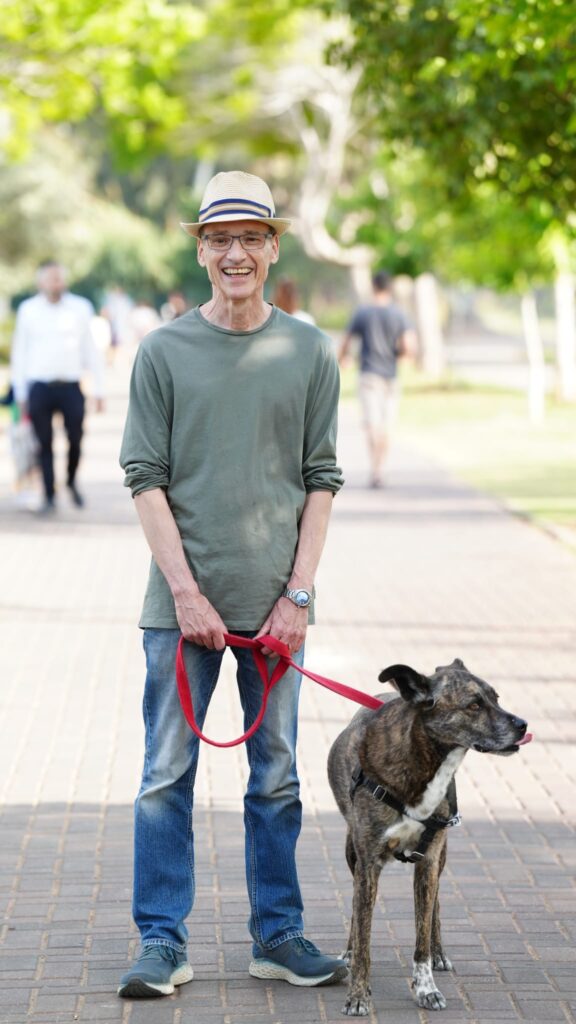
The truth is, I don’t have much first-hand experience of animals since I’m a city boy. Unlike my cousins, who grew up in a kibbutz agricultural commune, I’m not familiar with many animals. The one exception is dogs, which my family always kept. Our current one is the ten-year old dog Carmen (seen in the photo here), whom we adopted from an animal shelter right after her birth. Would I like to be born as a dog? While some dogs are lucky, being raised by a loving person who might own a nice garden to boot, others suffer miserably at the hands of their human owners. Dogs, like humans, are not all dealt the same cards in life!
- Meir Shahar, “The Donkey in Late-Imperial and Modern North China,” Asia Major 30.2 (2017): 71-100. ↩︎
- Vincent Goossaert, L’interdit du boeuf en Chine. Agriculture, éthique et sacrifice (Paris: Collège de France, 2005), recently translated as The Beef Taboo in China: Agriculture, Ehtics, Sacrifice (Honolulu: University of Hawai’i Press, 2025). ↩︎