We are delighted to hear from Joachim Boittout about a recent workshop held at the École normale supérieure de Lyon this October.
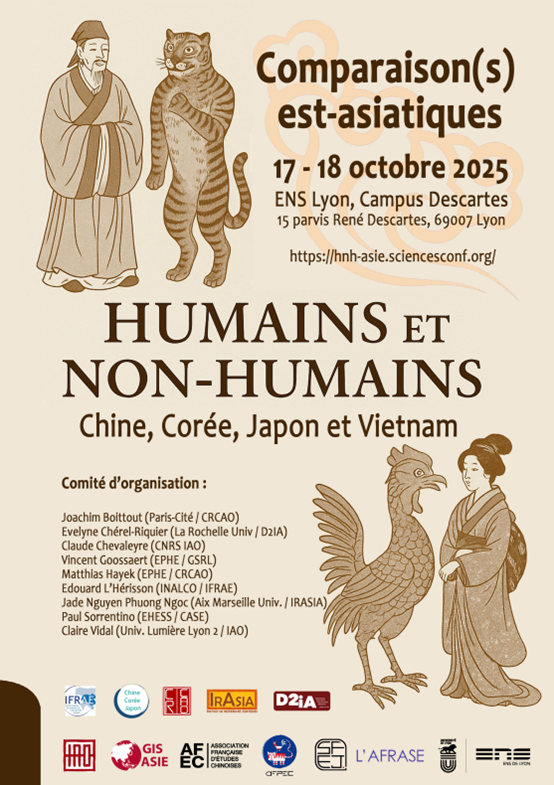
The “Humains et non-humains (Chine, Corée, Japon et Vietnam)” International Workshop took place at the École normale supérieure de Lyon, France on 17-18 October 2025. It was organised by the Association Française d’études Chinoises, the Association Française pour l’étude de la Corée, the Société Française d’études Japonaises, and the Association Française pour la recherche sur l’Asie du Sud-est, as well as the Institut d’Asie Orientale. It was supported by a variety of research centres, including the CRCAO, IFRAE, CCJ, D2ia, and the IrAsia.
The aim of this workshop was to gather young researchers whose academic interests, although divergent in their geographical and temporal scopes as well as disciplinary approaches, intersect on a common focus: the relations and entanglements between humans and non-humans in the cultural context of East Asia. By creating a place for academic discussion between different cultural eras and a plurality of disciplines from the humanities, this new and challenging forum’s purpose was to explore emerging research topics by encouraging scholars to go beyond anthropocentrism when engaging with East Asia-related topics.
Including a wide range of voices across two days and six panels, the workshop sought to cover different categories of non-humans. This included gods and spirits and the liminal spaces where their existence intersects with human activities, as well as fictional characters, whose creation by humans and subsequent dissemination in public spaces endow them with an autonomy that triggers responses and interactions from human spectators, consumers, and political subjects. The workshop’s remit also included animals and their environment, in particular where human interventions, usually aimed at utilising animals to increase knowledge and/or control over natural resources, reconfigured human-animal relations in ways that grant non-humans unexpected agency and, eventually, a determining presence in the human lives of different East-Asian areas.
Non-human animals were taken to be of primary importance in the workshop’s discussions, starting with the keynote delivered by Prof. Vincent Durand-Dastès. Retracing narratives on the gibbon, ever a fascinating species in Chinese history and literature, this talk expanded the understanding of the moral singularity this monkey was endowed with during imperial times.
With a wide scope – both in terms of time and space – the first panel was devoted to animals, with four presentations by early-career scholars exploring different dimensions of human-animal entanglements that all demonstrated the transforming effects of animals’ presences on human lives. While Na Yen explored the centrality of feeling and bodily sensations of coastal climate and marine fauna on knowledge production mechanisms in Qing dynasty Guangdong, Maria Coma-Santasusana showed, in her fieldwork carried out in pastoral Tibet, how specific individuals come to be granted a vitality that sets them apart from other animals of the herd, challenging political and economic injunctions of rationality and profitability. Working on liberatory rituals (fangsheng 放生) during late imperial and Republican times, Laura Boyer-Meng presented the rationale and impacts of liberating animal lives in human environments, where their presence was known and visible to all. Introducing the findings of in-depth fieldwork with Paiwan hunters in Eastern Taiwan, Agathe Lemaitre demonstrated on the longstanding imaginary of the clouded leopard, which is now extinct yet remains ever-present in discourses and representations.
After two days and six panels, the workshop concluded with a roundtable discussion that acknowledged the productive and ambitious encompassing approach chosen, which enabled scholars with different disciplinary backgrounds and dealing with different East Asian areas to reflect on modes, spaces, and terminologies of human and non-human interactions. The full programme is available here.