We are delighted to hear from Prof. Piotr Adamek SVD about a recent symposium held at Fu Jen Catholic University, Taiwan this September.
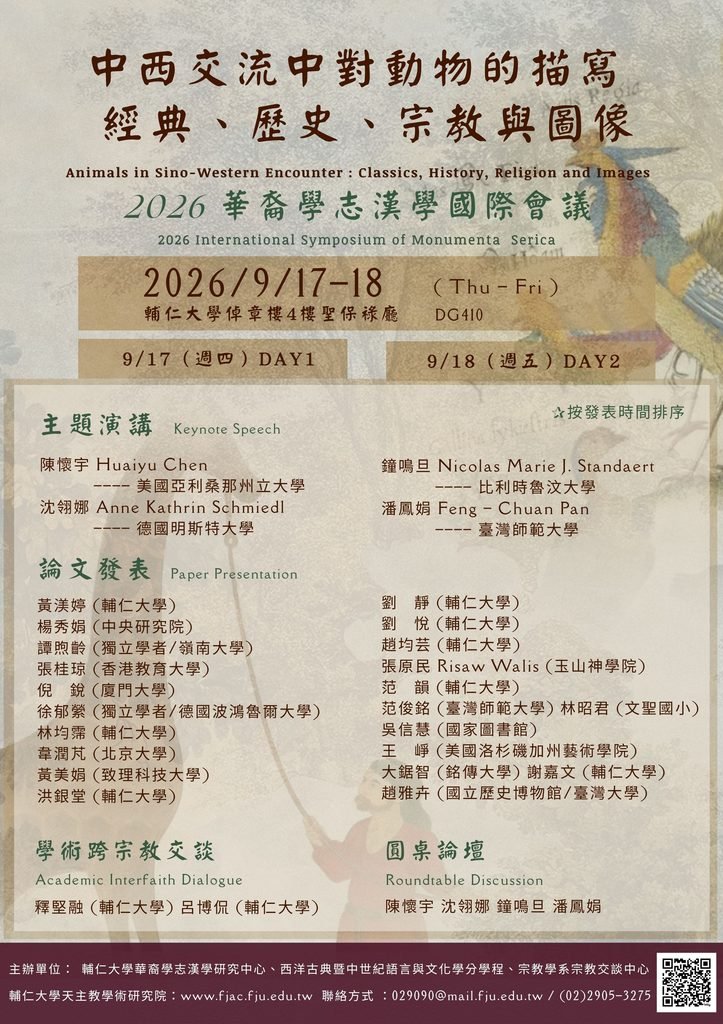
The international Symposium “Animals in Sino-Western Encounter: Classics, History, Religion and Images” took place at Fu Jen Catholic University in New Taipei City, Taiwan, on September 17–18, 2026. Jointly organized by the Monumenta Serica Sinological Research Center and the Program in Western Classical and Medieval Culture, the event fostered a rich international dialogue among scholars from around the world.
This gathering critically re-examined the multifaceted role of animals in Sino-Western encounters. The sessions analysed cross-cultural human-animal relations and their shifting imagery in both China and the West through interdisciplinary research drawing from classics, philosophy, history, religion, and literature. In doing so, the forum discussed past scholarly contributions, promoted exchange on recent research, and deepened ongoing international dialogue concerning how Eastern and Western cultures perceive the animal world.
The academic program was anchored by four keynote addresses across the programmed two days which showcased the global breadth of the event. Prof. Huaiyu Chen 陳懷宇 (Arizona State University) opened the plenary sessions with a lecture tracing the linguistic and cultural shifts associated with felines across Eurasian networks. Prof. Anne Schmiedl (University of Münster) then delivered a comparative study of the spiritual and allegorical dimensions assigned to the hare in Eastern and Western traditions. Prof. Nicolas Marie J. Standaert (KU Leuven) commenced the second day by offering methodological frameworks that positioned animals as active mediators in historical encounters. Finally, Prof. Pan Feng-chuan 潘鳳娟 (National Taiwan Normal University) concluded the keynote series by decoding early Jesuit cross-cultural theological translations of the lamb and the four mythical creatures.
Beyond the keynote addresses, the symposium was comprised of eight thematic sessions exploring human-animal dynamics. Initial panels examined comparative cultural imagery and sacred metaphors, tracing the social functions of felines, animal layouts in Catholic and Daoist ritual spaces, and the morphological shifts of hybrid deities. Discussion then moved to spiritual transformations, animal rebirth narratives in Pure Land Buddhism, and the sanctification of parrots and deer across Eastern and Western faiths. Panels also engaged with literary and scriptural borderlands, contrasting bird symbolism in Biblical and classical Chinese texts.
Academic Interfaith Dialogue brought with it a profound scholarly exchange between a Catholic priest, Fr. Wojciech Rybka, and a Buddhist nun, Ven. Shi Jianrong 釋堅融, both university professors. Together, they co-examined the intricate layers of animal symbolism within Buddhism and Christianity. Moving beyond mere text-critical analysis, this dialogue illuminated how both traditions utilise non-human lives to articulate deep truths about the cosmos, morality, and the divine. This rare convergence demonstrated that historical animal studies can serve as a powerful vehicle for contemporary spiritual and interreligious understanding.
The symposium culminated in a roundtable that gathered the keynote speakers for a reflective session structured around the current and future state of the field. Looking back at the papers and discussions from the past two days, the speakers debated the most significant takeaways and critical research gaps. The participants mapped out future avenues of research, including more focused workshops alongside dedicated research on the multifaceted role of animals in East-West encounters. Ultimately, this fruitful convergence of meticulous scholarship and transcultural reflection successfully advanced the boundaries of historical animal studies, leaving participants with a renewed, collaborative roadmap for the future.